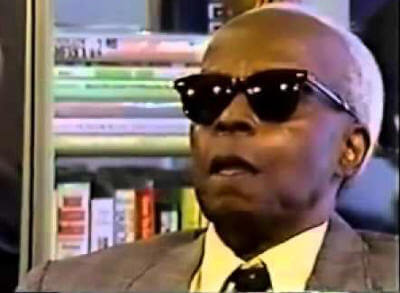

He spent 16 years crossing Africa on foot, by bus, and by boat — gathering what schools had buried for centuries. They never forgave him for it.
There is a particular kind of danger that comes from a Black man who refuses to accept the story he was given.
Chancellor Williams was that kind of man.
He didn't write op-eds. He didn't give TED Talks. He went to the source — across 26 African countries, through more than 100 language groups — and brought back what the academic establishment had either ignored or actively suppressed. What he produced was a masterwork: The Destruction of Black Civilization: Great Issues of a Race from 4500 B.C. to 2000 A.D.
You've probably never been assigned it in school.
That's not an accident.
Who Was Chancellor Williams?
Chancellor Williams was born on December 22, 1893, in Bennettsville, South Carolina. His father had been born into slavery. His mother worked as a cook, nurse, and evangelist. From the beginning, Williams understood what it meant to survive in a country that had designed your degradation.
He was curious from childhood — not just about his own circumstances, but about the roots of those circumstances. As he later said in an interview:
"I was very sensitive about the position of black people in the town… I wanted to know how you explain this great difference. How is it that we were in such low circumstances as compared to the whites? And when they answered 'slavery' as the explanation, then I wanted to know where we came from."
That question drove everything.
Williams received his undergraduate degree in Education and a Master of Arts in History from Howard University. He studied abroad as a visiting research scholar at the University of Oxford in England and at the University of London. He later earned his Ph.D. in sociology from American University in 1949.
But credentials weren't the point. The question was the point.
Chancellor Williams began his field research in African history in Ghana in 1956. His primary focus was on African achievements and autonomous civilizations before Asian and European influences. His last major study in 1964 covered an astounding 26 countries and more than 100 language groups.
This was not a man who read about Africa in university libraries. He went there. He walked that ground. He sat with elders and examined ruins and pieced together a history that the Western academy had declared didn't exist.
The Book That Changed Everything
The Destruction of Black Civilization took Chancellor Williams sixteen years of research and field study to compile. Sixteen years. That's not scholarship as career advancement, but scholarship as mission.
The book is built around a central question:
"If the Blacks were among the very first builders of civilization
and their land the birthplace of civilization, what has happened
to them that has left them since then at the bottom of world society?"
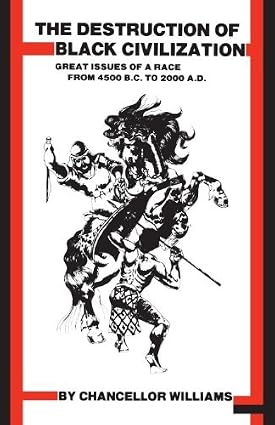
The question he asked is not radical, but rational. It is the question every honest student of history should be asking. And yet it is the question the academy refuses to answer — or even to ask.
The prevailing sentiment taught in schools at the time about Africa from even the most 'liberal' white authors (and their Negro disciples)was, 'You belong to a race of nobodies. You have no worthwhile history to point to with pride.' His book was intended to be "a general rebellion” against that programming.
Williams knew what he was doing and who would resist him. He did it anyway.
The book documents the rise of great African civilizations — their governance, their science, their architecture, their philosophy — and then traces the mechanisms by which those civilizations were dismantled: invasion, internal division, religious conquest, and the systematic erasure of historical memory.
Through a comprehensive blend of historical analysis and incisive critique, Williams unveiled the deliberate mechanisms of disruption — both external and internal — that contributed to the global diminishment of Black cultural and political sovereignty.
This is not victimhood literature. This is forensic history. Williams is examining a crime scene and naming what happened.
Why Schools Don't Teach Him
Here is the uncomfortable truth: the suppression of Chancellor Williams is not a conspiracy theory. It is a policy.
American education is built on a particular story — one in which Africa has no significant history before European contact, in which kidnapped Africans had no civilization worth mourning, and in which the progress of humanity flows through Greece to Rome to Europe to the United States.
Chancellor Williams's work not only complicates that story, but it demolishes it.
Had his work been included, generations of Black children would have entered the world knowing they came from something — not nothing. That knowledge alone changes everything. But it would also have required the entire mythology of European civilization as humanity's pinnacle to face a reckoning. That is precisely why it wasn’t.
As Williams himself noted, "researching African history is more tedious, laborious, and time-consuming than is true in other unsuppressed fields." Notice the word he chose: unsuppressed. He wasn't complaining about limited sources. He was naming what had been done to those sources deliberately.
When a scholar of Williams's stature names suppression as a structural condition of his field — not a temporary gap, but an active and ongoing project — that is testimony worth taking seriously.
And yet his work does not appear in K–12 curricula. It is not assigned in the standard Western Civilization survey courses. It is not stocked in airport bookstores alongside the approved histories of the ancient world. As Frederick Douglass made clear in his landmark 4th of July speech, this exclusion was by design.
What you get instead is sanitized ancient Egypt — deracinated, stripped of its African identity, repackaged as a kind of pre-European European civilization. You get Rome and Greece without their African intellectual debts. You get slavery without the empires that preceded it.
Chancellor Williams gave you the full prohibited picture. That is why he has been quietly set aside.
Chancellor Williams was not alone in this suppression. We have documented the same treatment of Cheikh Anta Diop and John Henrik Clarke — scholars whose work dismantles the same mythology Williams spent his life challenging.
This is not ancient history. We recently exposed a contemporary example of this erasure happening right now on Amazon. Read the Samuel Goldstein exposé
What He Actually Showed the World
Williams's central arguments, documented through decades of field research, include:
African civilization predates European contact by thousands of years.
The great civilizations of the Nile Valley — Nubia, Kush, Kemet — were Black African civilizations. Their achievements in mathematics, medicine, architecture, governance, and philosophy were not borrowed from elsewhere. They were the source.
The destruction of Black civilization was deliberate and multi-fronted.
It was not simply that Africans lost wars. It was that invaders systematically dismantled the cultural memory, the religious systems, the leadership structures, and the records of those civilizations. European colonial powers employed a ruthless blend of military aggression, political manipulation, and economic exploitation to systematically dismantle the intricate social, political, and economic structures that had sustained African civilizations for centuries.
But perhaps most devastating was the assault on African spiritual systems.African people did not simply lose their land and their governance — they were systematically cut off from their sacred traditions, their ancestral wisdom, and their cosmological understanding of who they were.
When you destroy a people's relationship with their God, their ancestors, and their understanding of the sacred, you don't just conquer them — you disconnect them from the source of their identity and power.
Spiritual destruction was not a byproduct of conquest. It was a strategy.
Internal division was weaponized.
Williams was unflinching about the role that internal conflict played in the collapse of African unity. He didn't excuse outside forces to avoid addressing within. He named both, which made him inconvenient to everyone.
Recovery requires historical truth.
You cannot build on a foundation you don't know exists. That was the core argument of Williams's life: that Black people could not move forward without recovering the full truth of where we came from.
Why This Man Should Be Taught in Every School
The Destruction of Black Civilization is a widely read classic exposition of the history of Africans on the continent — and the people of African descent in the United States and in the diaspora. It is, for many readers, the first time they have encountered African history told from an African perspective, centered on African experience, by a scholar who was willing to sacrifice his career comfort for the truth.
Williams died on December 7, 1992 — 98 years old, having lived through slavery's shadow, Jim Crow, the Civil Rights era, and the Black Power movement. He saw enough of the world to know that the absence of our people's history from the curriculum was not an oversight. It was architecture.
Every teacher who bypasses this work is participating in that architecture, whether they know it or not.
Every student who graduates without knowing Chancellor Williams's name has been failed.
That failure is not theirs. It belongs to a system that was never designed to give them the truth.
A Personal Note
I don't believe in coincidence.
Chancellor Williams was born in Bennettsville, South Carolina. So was his hunger — the hunger to understand why Black people had been left at the bottom of a world their ancestors built. I grew up in South Carolina, too. On that same soil and experienced, in that state, that same silence in the schools about who we really were.
And in 1956 — the year I was born — Chancellor Williams arrived in Ghana and began the field research that would become The Destruction of Black Civilization.
He was starting. I was just arriving.
By the time I was old enough to ask the questions he spent his life answering, the book existed. The work had been done. All I had to do was find it — and then refuse to keep it to myself.
That's what this work is. That's what Black History Unfiltered is.
He started in 1956. You're reading this now. Nothing about that is an accident.
The Work Continues
Chancellor Williams did his part. He gave us 16 years of field research that resulted in The Destruction of Black Civilization. He asked the question no one else was bold enough to formalize: What happened to us, and who did it, and how do we reclaim what was taken?
Now that work belongs to us.
If you are ready to go deeper — to study the scholars they suppressed, the histories they buried, and the truths they have spent centuries trying to keep out of your hands — Black History Unfiltered is built for exactly that purpose.
This is not a course about feeling good about the past. It is a course about understanding the full scope of what happened — and equipping yourself with the knowledge to move through the present with clarity and power.
Enroll in Black History Unfiltered
Chancellor Williams didn't do what he did so the knowledge could sit on a shelf. He did it so you could use it.
Professor Kamau Kenyatta teaches African World Studies and is the author of The White People Show and Black Folk's Hair Revised Edition. His work centers on restoring suppressed Black history to the people it belongs to.
0 Comments