


They told you Columbus discovered America in 1492.
They told you that before Europeans arrived, the Americas were isolated — cut off from the rest of the world, waiting to be "found."
They told you Africans had no ships. No navigation. No capacity to cross oceans.
Every single one of those claims is a lie — and a Rutgers University professor spent his entire career proving it. That scholar was Ivan Van Sertima — and, like Wiener before him, he would pay a price for telling the truth.
You've probably never heard of Ivan Van Sertima.
That's not an accident.
The Man Who Came Before Van Sertima
Before we get to Van Sertima, you need to know a name almost nobody teaches.
Leo Wiener.
Wiener was a professor of Slavic Languages and Literatures at Harvard University. Not a fringe thinker. Not a community activist with an agenda. A Harvard professor publishing through mainstream academic channels. In 1920, he released the first volume of a three-volume scholarly work titled Africa and the Discovery of America — a meticulous linguistic study that documented African loan-words embedded in Native American languages across the continent.
Think about what that means. Language doesn't lie. Words don't cross an ocean by accident. If Native American languages contained African root words — words that couldn't be explained by European contact — then Africans had to have been there first.
Wiener's conclusion: the presence of African vocabulary in indigenous American languages was evidence of direct contact between African and Native American peoples before Columbus ever sailed. He documented it across three volumes of detailed scholarly analysis, published by a reputable press, written by a sitting Harvard professor.
The academy buried it anyway.
His work was dismissed and largely forgotten — not disproven, just set aside. It took over fifty years for another scholar to pick up that thread and carry it forward.
That scholar was Ivan Van Sertima.
This is the part the system doesn't want you to see: the suppression of Black history isn't a single event. It's a pattern. It's a policy. Wiener established the linguistic foundation in 1920. Van Sertima built the full evidentiary case in 1976. Both were marginalized by the same institutional machinery protecting the same lie. When you understand that, you understand that what happened to Van Sertima wasn't about him — it was about making sure this line of inquiry never reached you.
It almost worked.
Who Was Ivan Van Sertima?
Ivan Gladstone Van Sertima was born in 1935 in Guyana, South America, when it was still under British colonial rule. He was not some outsider throwing stones at academia from the fringe. He earned his degree with honors from the School of Oriental and African Studies at the University of London — one of the most respected institutions in the world for the study of Africa and Asia. He went on to earn his graduate degree from Rutgers University, where he taught in the Africana Studies Department from 1972 until his retirement in 2005.
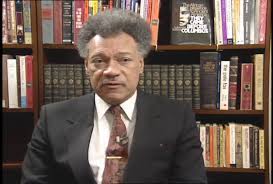
He was also a linguist fluent in Swahili — he published a Swahili Dictionary of Legal Terms based on fieldwork in Tanzania. He was a literary critic distinguished enough to be asked by the Nobel Committee of the Swedish Academy to nominate candidates for the Nobel Prize in Literature. He was a visiting professor at Princeton University.
Ivan Van Sertim was not a man guessing. This was not a man ranting on the internet. This was a credentialed scholar at a major American research university who followed the evidence wherever it led — even when it led somewhere the system refused to go.
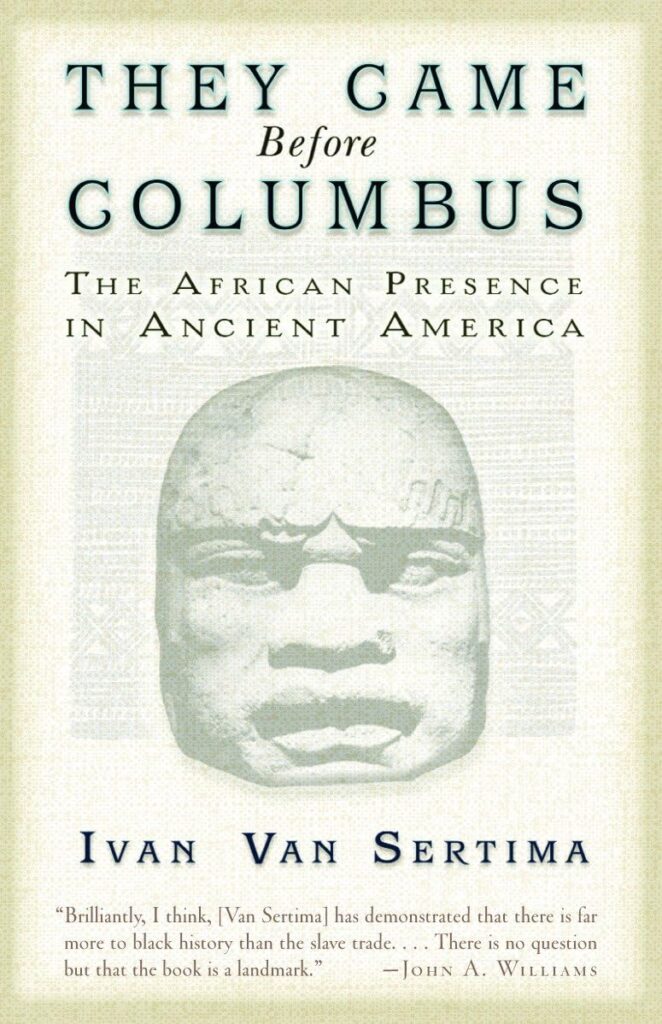
In 1976, while still a graduate student, Van Sertima published They Came Before Columbus: The African Presence in Ancient America. It went on to become a bestseller, now in its 29th printing. In 1981, it won the Clarence L. Holte Literary Prize for excellence in literature and humanities related to the African diaspora. In 1979, Van Sertima founded the Journal of African Civilizations, which he edited for decades — documenting African contributions to science, mathematics, medicine, astronomy, engineering, and navigation.
The man had receipts. Plural.
What Did He Prove?
Van Sertima's central argument in They Came Before Columbus is this: Africans made contact with the Americas centuries — possibly millennia — before 1492. And he didn't just say it. He documented it from multiple independent lines of evidence.
The Olmec Colossal Heads
The Olmec civilization flourished in what is now Mexico beginning around 1500 B.C. They left behind massive stone heads — some weighing up to 40 tons — carved with unmistakably broad, flat-nosed, full-lipped features. These heads have been found across Mesoamerica, and they predate Columbus by over two thousand years. Ivan Van Sertima argued that their physical features reflected African contact with the Olmec people. Polish craniologist Andrez Wiercinski examined skeletal remains from key Olmec sites, including Tlatilco and Monte Alban, and documented the presence of skulls with African-type traits at those same sites. The heads were already there. The bones were already there. The story was already there — waiting to be told.
Columbus's Own Journals
Here's the part that should make your jaw drop: the evidence didn't only come from Van Sertima's analysis. It came from Christopher Columbus himself.
When Columbus arrived in the Caribbean, the indigenous people of Hispaniola told him — through interpreters — that black-skinned people had already been there. They came from the south and the southeast. They brought spears with tips made of a metal alloy the Native people called gua-nin. Columbus was curious enough to send samples back to Spain. When the Spanish tested the metal, they found it was composed of gold, silver, and copper in ratios nearly identical to the alloys used by West African smiths of that era. Columbus recorded this in his own journals.
The first witness to African presence in the Americas before 1492 was Christopher Columbus.
The Botanical Evidence
Van Sertima also documented the presence of African-origin plants in the Americas — plants that had no business being there if the two continents had zero contact before 1492. He noted evidence of African products crossing the Atlantic and Native American products appearing in Africa before any European-documented trade could account for it. The plants don't lie. DNA doesn't lie. Trade goods don't teleport.
The Mali Expeditions
Van Sertima also documented the historical record of Mansa Abu Bakr II, the emperor of Mali, who in 1311 sent a fleet of 2,000 boats westward across the Atlantic. The fleet never returned. Medieval Arab scholar Abu-Zayd Abd ar-Rahman ibn Khaldun recorded this expedition. This wasn't a fantasy — it was a documented historical event from a documented historical empire. Ivan Van Sertima argued that at least some of those boats reached the Americas centuries before Columbus ever set sail.
Why Did the System Try to Bury Him?
Here's where we need to be honest about what suppression actually looks like.
They didn't burn Van Sertima's books. They didn't arrest him. What they did is more subtle — and more dangerous, because it's harder to see.
They dismissed without engaging. The mainstream academic response to They Came Before Columbus wasn't detailed scholarly rebuttal. It was institutional cold-shoulder. Mesoamerican specialists largely chose to ignore the book rather than engage it on its own terms. His Journal of African Civilizations was excluded from Journals of the Century — a prestigious compilation — not because its content was proven wrong but because it existed outside the approved academic network.
They published the book through a non-academic press and used that against him. They Came Before Columbus was published by Random House — a major mainstream publisher — rather than an academic press. The academic gatekeeping establishment used this to classify his work as "popular" rather than scholarly, even though Van Sertima was actively teaching at Rutgers and his evidence came from archaeology, linguistics, anthropology, and primary historical records.
They accused him of the very harm he was fighting. The most dishonest line of attack was accusing Van Sertima of "robbing Native American cultures" — as if saying Africans and Native people had contact, trade, and relationships with each other somehow diminished Native people. Think about that framing. The people who genocided Native Americans were now styling themselves as the defenders of Native culture — to use that accusation as a weapon against a Black scholar who was documenting early evidence of African maritime civilization.
Van Sertima himself addressed this directly. He never claimed Africans created Olmec civilization. He claimed contact. He claimed influence. He claimed the relationship between peoples — which is how all human civilization has always worked.
They never testified before Congress. He did.
On July 7, 1987, Ivan Van Sertima went to Washington and testified before a United States Congressional committee to oppose celebrating the 500th anniversary of Columbus's so-called "discovery." He said: "You cannot really conceive of how insulting it is to Native Americans... to be told they were 'discovered.'"
A Black scholar from Guyana, standing in the halls of the United States Congress, telling the government of this country that the story they'd been celebrating for 500 years was built on a lie.
That's not fringe. That's courage.
What You Were Never Supposed to Know
The suppression of Van Sertima's work isn't really about Van Sertima.
It's about what his work means.
If Africans were skilled enough navigators to cross the Atlantic before 1492 — if they were trading with civilizations in the Americas, influencing art and architecture and metallurgy — then the entire story of African people as passive victims waiting to be enslaved collapses. It collapses completely.
The slave trade required a story. The story was that Africans had no civilization, no science, no ships, no ambition, no capacity for self-determination. That story was built deliberately, maintained aggressively, and protected institutionally. Every scholar who threatened that story had to be managed — discredited, marginalized, ignored, or buried.
Ivan Van Sertima threatened the story. So they buried him.
But the Olmec heads are still standing. Columbus's journals still exist. The skulls at Tlatilco haven't changed. The metal alloy ratios haven't changed.
The evidence is still there.
The assault on Van Sertima's scholarship was not unique.
As Frederick Douglass warned in his landmark Fourth of July speech,
America has always had a system for silencing what it cannot afford for Black people to know.
Why Ivan Van Sertima's Work Still Matters Today
You can find They Came Before Columbus on Amazon. it is still in print. Pick it up. Read his evidence. Examine his sources. Don't take my word for it and don't take the academy's word for it either.
Because that's what they were always afraid of — not that you'd believe Ivan Van Sertima, but that you'd read him and think for yourself.
If you're ready to go deeper — to study the full scope of what was hidden from you, who hid it, and why — that's exactly what the Black History Unfiltered course is designed for.
This is the history you were owed.
Enroll in Black History Unfiltered →
What similarities do you see between Ivan Van Sertima and Cheikh Anta Diop?
Professor Kamau Kenyatta is an author, speaker, and professor of African World Studies at William Paterson University. His mission is to share suppressed Black history to heal the wounds of racism and reclaim hidden knowledge.
0 Comments